
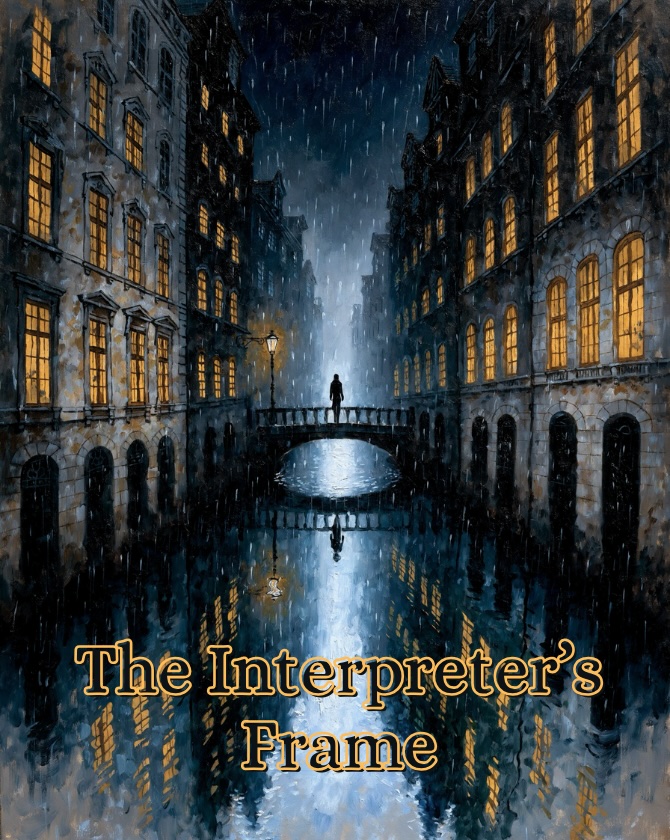
Content Summary
A simultaneous interpreter is hired for a twelve-hour job in an unnamed city threaded with canals and clock towers. By the end of the night, she will have to choose which version of reality gets to survive. Kira Vance translates in real time. Not consecutively — simultaneously. She hears one language and speaks another at the same time, holding both in her head without letting either contaminate the other. It is, by any cognitive measure, one of the most demanding tasks a human brain can perform, and Kira does it the way a long-distance swimmer does open water: with controlled dissociation, a partitioned mind, and the absolute discipline of never, ever choosing sides. The interpreter is neutral. The interpreter is a conduit. The interpreter does not have opinions about the content. Tonight, the content has opinions about her. She's been hired by Mira Kell — a theoretical physicist whose work on observer-dependent frame mechanics is either the most important physics since relativity or a grief-fuelled hallucination dressed in equations. Mira lost someone. The equations came after. The relationship between the loss and the physics is not metaphorical. Mira believes — and her mathematics supports — that observation doesn't simply measure reality. It selects one frame from a set of co-existing frames, and the act of selection destroys the others. Every measurement is a funeral. Every observation is a choice someone didn't know they were making. The job is straightforward: interpret for Mira at a private meeting in the city's industrial district. But the meeting is with Adrian Voss, a man who should not exist in the form Kira encounters him. Voss is in his fifties. He is also in his twenties. He speaks with six voices — not sequentially, but simultaneously, layered, as though six versions of the same man are talking at once from slightly different positions in time. His body shows the evidence: asymmetries that aren't medical, textures that shift under direct observation, a left hand that appears to be in a different season than his right. Fused to his chest, visible through his open shirt, is a device — the divergence engine, a machine that does what Mira's equations describe. It holds multiple frames open at once. It has been holding Voss open for thirty years. He built it to save Elias Carver. Carver is sixty, and he is the original sin of this story — the man who constructed the first device decades ago, who caused the substation fire that proved frame mechanics were real by burning a hole in the boundary between two versions of the same night, and who has been distributed across frames ever since, stretched thin, guilt-ridden, unreachable by any single version of reality. Voss built the engine to find him. The engine found him. But it also found everything else: every frame where the fire happened differently, every version of the city where the canals run in different directions, every clock tower showing a different time because it is a different time. Kira's job is to interpret between them — Mira's precise, grief-sharpened physics and Voss's six-voiced, frame-scattered testimony and Carver's guilt-fractured whisper — and she is very good at her job. Too good. Because simultaneous interpretation requires exactly the cognitive architecture that frame mechanics exploits: the ability to hold two incompatible systems in the mind at once without collapsing either into the other. Kira doesn't just translate between frames. She is the mechanism by which the frames stay separate. Which means when the twelve hours are up and the engine reaches critical — when the frames begin to collapse toward a single resolution — Kira is the one who will have to choose. Not which translation is correct. Which frame survives. The other burns. The story unfolds across a single night in six districts of a city that may be six versions of the same district. The canals reflect things that aren't above them. The clock towers disagree. And an interpreter who has spent her entire career refusing to choose sides discovers that neutrality is not a position. It is a frame. And it is collapsing.